

Google is no longer the only gatekeeper to your customers.
More people now ask ChatGPT for restaurant recommendations. They ask Gemini to compare service providers. They rely on Google’s AI Overviews instead of scrolling through ten blue links. If your business isn’t optimized for these AI-driven answers, you’re invisible in a growing chunk of searches, no matter how well you rank on traditional Google.
This is where GEO and AEO come in. These two concepts are reshaping SEO, and every business in Kenya still relying on old-school keyword tactics needs to understand them now, not later.
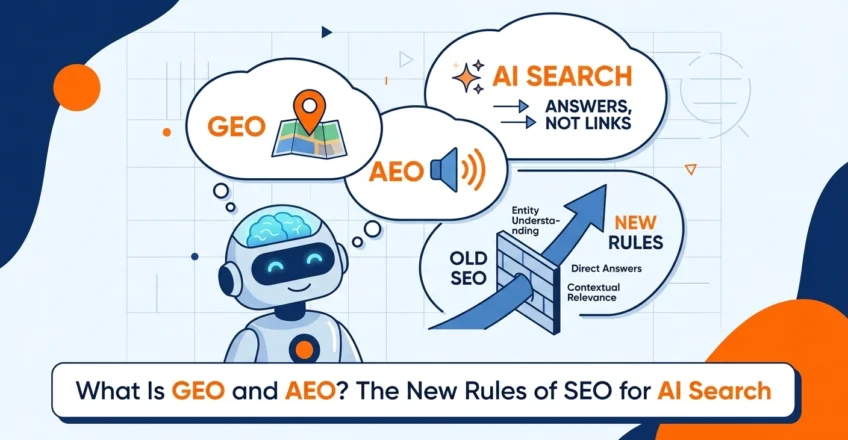
GEO is the practice of optimizing your content so AI tools like ChatGPT, Google AI Overviews, and Gemini pull it into their generated answers.
Traditional SEO focuses on ranking a webpage on a results page. GEO focuses on something different: getting your brand, product, or expertise mentioned directly inside an AI-generated response. The user never clicks through to your site. They just see your business named as the answer.
Think about the shift this creates. If someone asks an AI tool “best digital marketing training in Nairobi” and your content is structured well, the AI might name your business directly in its answer. No click needed. No competition with nine other blue links. Just visibility at the moment of decision.
AEO is closely related but slightly narrower. It focuses on optimizing content to directly answer specific questions, the kind people type into search bars or ask voice assistants.
AEO content is built around clear, direct answers. Think FAQ-style structure, concise definitions, and content that answers a question in the first two sentences instead of burying the answer under 500 words of introduction.
AI systems and voice assistants favor this format because it’s easy to extract and repurpose. If your content rambles before getting to the point, AI tools skip it in favor of a competitor who answers faster.
A few realities are driving this shift:
AI Overviews are now a default part of Google search. Many searches show an AI-generated summary before any organic result. If your content isn’t part of that summary, you lose visibility even if you rank #1 traditionally.
People are searching directly inside AI tools. ChatGPT, Gemini, and similar platforms are becoming search engines in their own right. Businesses that ignore this are missing an entire discovery channel.
Trust signals matter more than ever. AI tools tend to pull from sources that are clear, well-structured, and authoritative. Vague or poorly organized content simply doesn’t get selected.
Early movers get the advantage. Most businesses in Kenya haven’t touched GEO or AEO yet. That’s an opportunity. The businesses that adapt now will dominate AI-driven visibility before it becomes the norm.
Traditional SEO still matters. Keywords, backlinks, and technical site health are not going away. But GEO and AEO add a new layer on top:
The businesses that win going forward will need all three working together, not one instead of the other.
You don’t need a complete overhaul to start. A few practical shifts make a real difference:
Answer questions directly and early. Structure content so the answer to a question appears in the opening sentences, not after a long introduction.
Use clear headings that mirror real questions. “What is GEO?” works better for AI extraction than a vague heading like “Understanding the New Landscape.”
Back up claims with specifics. AI tools favor content with concrete details, numbers, and examples over generic statements.
Structure content for scannability. Bullet points, short paragraphs, and clear formatting help AI models parse and extract your content accurately.
Build topical authority. Publishing consistently on a subject signals expertise, which increases the odds of being cited as a trusted source.
GEO and AEO aren’t replacing SEO. They’re extending it into a new frontier where AI, not just search engines, decides what businesses get seen. Ignoring this shift means losing visibility in exactly the place your customers are increasingly looking.
The businesses that adapt early will own this space. The ones that wait will spend the next few years playing catch-up.
Understanding GEO and AEO in theory is one thing. Knowing how to apply them to a real website, a real business, and a real content strategy is another.
At OraDMT, our SEO training now includes a full module on GEO and AEO, covering how to optimize your content for Google AI Overviews, ChatGPT, and Gemini alongside traditional search ranking factors.
Our intake is now open. Whether you’re a business owner who wants to future-proof your online visibility or someone looking to build a career in digital marketing, this is the right time to get ahead of a shift most of your competitors haven’t even noticed yet.
Visit us at Westlands Business Park, 8th floor, or call/whatsapp us on +254745564273 for more information.


